
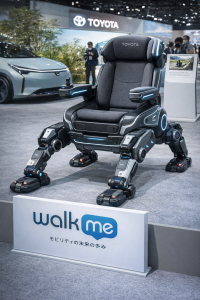
Stairs have long been a headache for wheelchair users, turning simple errands into a logistical nightmare by limiting access to many places. However, Toyota has found a creative solution to this problem, and showed the result at the Japan Mobility Show 2025. We are talking about Walk Me , an autonomous robotic chair.
Although this chair is still in the prototype stage, its purpose is to allow people with special needs to climb stairs or overcome other obstacles that are inaccessible to traditional wheelchairs. It is also capable of lifting the user so that they can get into cars and other vehicles or platforms located on elevated ground.
This robot is equipped with a variety of features that allow it to navigate difficult terrain by mimicking the movements of four-legged animals such as crabs. These include LiDAR systems, which use laser light to measure distances and create highly accurate, detailed three-dimensional images of objects and the environment, which the robot uses to avoid obstacles or overcome uneven surfaces.
When climbing stairs, the device first checks the height with its front legs and then pushes with its hind legs. Built-in radars prevent collisions with people or objects.
Compact design for everyday life
This is not a wheelchair, but an autonomous chair on four robotic legs. Instead of wheels, the chair has four independent robotic “legs”. The legs are upholstered in a soft, colorful material that performs a dual function: it protects sensitive internal components (such as sensors and motors) from external damage and also gives the device a pleasant and attractive appearance.
The chair has weight sensors that make sure that the person is sitting upright before the movement begins. If there is a risk of tilting, Walk Me automatically levels itself.
Comfort and control
The Walk Me seat adapts to your body shape. The curved back supports the spine, and the side handles allow you to control the direction – you can turn them or press the built-in buttons.
For complete convenience, voice control is provided: just say “kitchen” or “faster”, and the built-in computer will build a route or change the step speed. A small display on the armrest shows the battery level and distance traveled.
According to DPC Cars, the system uses smart balancing algorithms to keep the ride smooth even on difficult surfaces. Power is provided by a compact battery behind the back, which lasts for a full day of active use. Charging is simple – the device is plugged into a regular outlet.
If any part of the mechanism overheats, built-in sensors stop the movement and notify the owner.
Compactness and convenience in everyday life
One of Walk Me’s key advantages is its folding design. One presses a button, and in thirty seconds the chair removes its legs, bends its knees, and turns into a suitcase the size of a carry-on bag.
It can be stored in the trunk of a car or in the corner of a room. When you activate it again, the system automatically unfolds the legs, checks the balance and is ready to go.
So Walk Me is the result of years of research by Toyota in the field of robotics. Previous projects, such as the Human Support Robot (HSR) and the T-HR3 humanoid robot, have demonstrated the company’s commitment to assistive and remote control technologies. This latest innovation, however, shifts the focus from robotic assistance in homes to autonomous movement in public spaces. It embodies Toyota’s “Mobility for All” philosophy, where technology expands human freedom rather than restricts it.
