
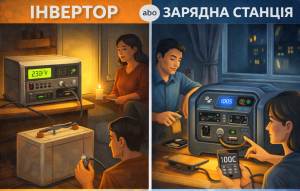
For several years now, Ukrainians have been living in a reality where power outages have become commonplace. Some people are used to keeping candles or power banks on hand, but this is often not enough when it comes to work, school, or even basic household needs.
Therefore, in the face of constant power outages, it is imperative to have an alternative energy source. Two solutions are most often discussed on the market today: inverters and portable charging stations. Today, we’ll take a look at each of them.
An inverter is an electronic device that converts direct current (DC), for example, from a battery (12V/24V), into alternating current (AC) 220V, which is used in household outlets, allowing you to connect standard equipment to alternative energy sources (solar panels, car batteries).
Principle of operation (inverter circuit)
An inverter works by converting direct current into alternating current using electronic components such as transistors or thyristors. The input current is supplied to the inverter, where it is first increased to the required level and then converted into alternating current of the desired frequency. The device uses special circuits that ensure the stability of the output signal, as well as protection against overloads or short circuits.
In the event of a power outage, the inverter automatically starts using the battery charge to keep important devices running.
Modern inverters are equipped with an automatic switching function, which guarantees an almost instantaneous switch to backup power (up to 20 ms), minimizing inconvenience.
Backup power inverters must be paired with batteries to ensure a stable supply of energy during accidents or outages. When choosing, it is important to pay attention to compatibility with the type of battery: lead-acid, gel, or lithium-ion. And also on the switching time, because a high-quality inverter provides an almost instantaneous switch to backup power.
Types of inverters:
- Electronic inverters. The device uses high-power transistors or other semiconductors to quickly switch the input DC current on and off to produce an alternating current at the output.
- Mechanical inverter. The device uses a motor-type rotary device and an electromagnetic switch to send direct current back and forth, and as a result, form alternating current. The only type of mechanical inverter that is still used for special purposes is the rotary phase number converter. It is used to convert single-phase electricity into three-phase electricity.
- Static inverters are used for special cases where a continuous flow of power is required, such as in emergency lighting systems. They are used in uninterruptible power supplies (UPS) to protect sensitive electronic equipment such as servers and hard drives.
What to connect to the inverter with care or avoid connecting at all:
- heating devices with high power;
- alternating current motors;
- powerful pumps, air conditioners, and refrigerators;
- gas boilers, circulation pumps, medical equipment, expensive power tools, if the inverter produces a modified (not pure) sine wave;
- and the inverter output must not be connected to the centralized network.
A charging station is a powerful portable battery that stores electricity (like a large power bank) and allows you to power various devices (smartphones, laptops, refrigerators, boilers) via USB, 220V sockets and other ports, providing autonomy and backup power, especially during power outages.
With the help of such a station, you can always provide even the usual level of comfort by connecting lighting, household appliances and electronic gadgets for charging wherever you are.
High-quality portable power plants have a high-strength sealed housing, a modern high-capacity battery, several types for charging and connecting receivers, and the ability to charge the built-in battery in various ways.
How the charging station works
The internal battery stores electricity, which is then converted by an integrated inverter into clean 220 V AC power as well as DC power (USB or DC connectors). Many models support charging from solar panels or a car cigarette lighter.
Main advantages:
- different charging options;
- operation in an enhanced mode;
- full battery recovery in just an hour;
- Depending on the IP modification, it is possible to operate up to ten devices simultaneously;
- battery capacity can be in the range of 210 W⋅h – 25 kW⋅h;
- do not harm the environment;
- are equipped with protection against voltage surges;
- some models have the ability to connect an additional battery.
Types of charging stations:
- Stationary charging stations. They are installed for a long time in a specially selected location, as they are intended for constant use. These charging stations are characterized by high power and can provide fast charging.
- Portable charging stations. They are compact enough to be easily carried from one place to another if necessary, which is why they are often used when hiking. They are characterized by their versatility, as they are often equipped not only with high-capacity batteries but also with solar panels, so they are suitable for charging various gadgets.
- Car charging stations.
Do not connect devices to the charging station that exceed its capacity, use unsafe plug-to-pin cables for mains connection, or place the station in humid or too hot/cold locations to avoid overheating, short circuits, and damage.
What is better for blackout?
When it comes to fast charging of gadgets and a router, a charging station is better suited, as it is more convenient, safer, automatically switches, and compact.
If you need to power the entire apartment or house, refrigerator or pump, it is better to purchase an inverter with a powerful battery (6-8 kW and 5+ kWh).
The best solution is to combine two types of alternative power supply.
